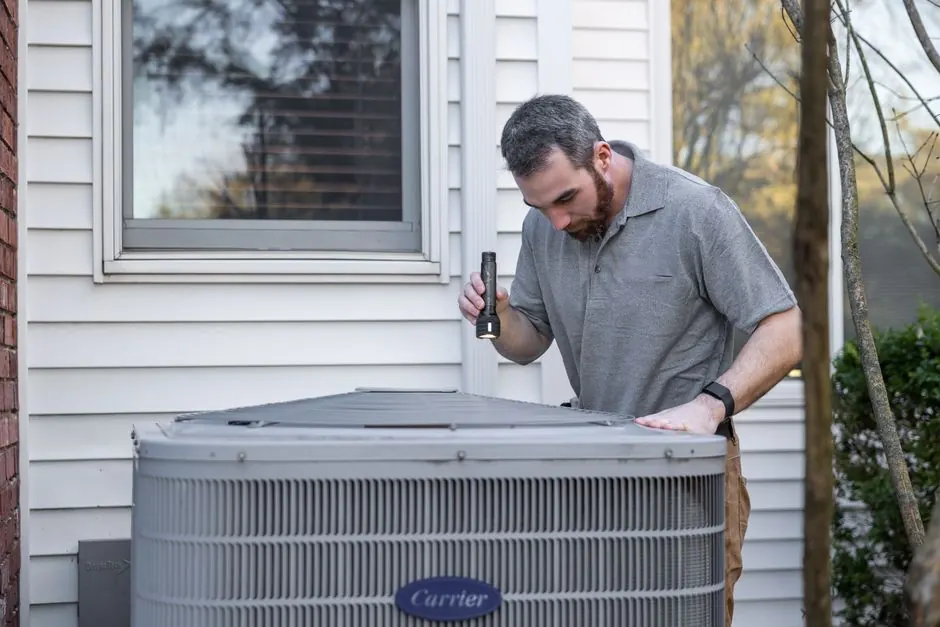
Full ignition diagnostic
We test the igniter, flame sensor, thermocouple, and gas valve in sequence with a multimeter and thermocouple tester. You get the actual readings, not a guess, and we identify the failed component before quoting the repair.
Every call starts with a full diagnostic and ends with a tested furnace. Here is what is covered in a standard repair visit, and what we quote separately if the job calls for it.
We test the igniter, flame sensor, thermocouple, and gas valve in sequence with a multimeter and thermocouple tester. You get the actual readings, not a guess, and we identify the failed component before quoting the repair.
Every no-heat call gets an inspection camera check of the heat exchanger. A crack means carbon monoxide in your supply air, so we verify it is sound before we call the job done. If it is cracked, you hear it from us directly.
We pull the blower, check the capacitor and bearings, and measure temperature rise at the supply and return. If airflow is restricted by a dirty filter or a duct problem, we tell you and fix what is fixable on the spot.
Manifold pressure gets set to the data plate with a manifold gauge set, and we run a combustion analyzer and CO check in the supply air before we leave. That is how we know the furnace is burning clean and safe.
We replace or clean the filter if it is due, write down the size for next time, and reset the control board. You leave with a working furnace and a clear idea of when to change the filter next.
Residential Furnace Repair in Saint Joseph is the diagnostic and mechanical work that restores heat to a single-family home's furnace, and it is needed the moment your system stops firing, blows cold air, or short cycles. A real repair starts with a combustion analyzer and a multimeter, not a guess. We test the igniter, flame sensor, thermocouple, gas valve, and limit switch in sequence, then pull the blower motor and inspect the heat exchanger with an inspection camera before we quote anything.
Most calls we run in Saint Joseph come down to five failures: a dirty flame sensor, a failed igniter, a bad blower motor, a faulty control board, or a tripped limit switch. Older homes near Hall Street and Museum Hill often still run 80% furnaces with standing pilots, while newer builds in Mitchell Woods and Sunset Park carry high-efficiency condensing units with inducer motors. If you are searching for residential furnace repair in Saint Joseph Missouri near me, we stock the common parts so most homes get heat back the same visit.
From the first phone call to the final temperature check, here is exactly what happens when you book us.
Schedule
Call or book online — a real human picks up and confirms a 2-hour arrival window.
Diagnose
Licensed tech inspects on-site, then walks you through the cause and your options.
Fix
The job is completed to code and done right the first time — no shortcuts, no surprises.
Guarantee
Every job backed by a written workmanship warranty — and we stand behind it.
Combustion analyzer
Measures flue gas oxygen, carbon dioxide, and carbon monoxide so we can set the furnace to burn clean and confirm there is no CO in the supply air.
Manifold gauge set
Verifies gas pressure at the manifold against the data plate. Wrong pressure means incomplete combustion, soot, and a shorter heat exchanger life.
Multimeter and thermocouple tester
Tests igniter resistance, flame sensor microamps, thermocouple output, and control board voltage so we replace only the part that actually failed.
Inspection camera
Lets us see the heat exchanger tubes without pulling the whole furnace. It is how we confirm a crack instead of guessing at one.
Blower motor puller and fin comb
Pulls stubborn blower wheels and straightens bent condenser and evaporator fins so airflow stays where it should be.
Vacuum pump and nut driver set
Standard on every van for evacuating lines, cleaning burner compartments, and getting panels off without stripping screws.
Sequence-of-operation testing
We follow the furnace's own startup sequence, from thermostat call to inducer to ignition to blower, and stop at the first step that fails. It is faster and more accurate than swapping parts and hoping.
NFPA 54 gas code compliance
Every gas repair follows NFPA 54 for venting, clearances, and combustion air. We pull local Saint Joseph building permits when the job requires one so the work passes inspection.
Temperature rise verification
We measure supply and return air temperatures and compare the rise to the data plate range. A rise outside spec means an airflow or gas pressure problem, even if the furnace is running.
CO safety check
Before we leave, we test for carbon monoxide in the supply air. It is a two-minute check that catches a cracked heat exchanger or a venting problem before it becomes a health issue.
01
What we do: Call (816) 339-6148 first thing. We hold same-day slots for no-heat calls and prioritize homes with kids, elderly residents, or exterior plumbing at risk. A tech arrives with igniters, flame sensors, and control boards on the van.
→ Most no-heat calls are back running the same day, usually within two to four hours of the tech arriving.
02
What we do: Leave the house and call your gas utility first, then call us. A boom on startup is delayed ignition, and a gas smell means a valve or fitting issue. We test the gas valve, manifold pressure, and all connections before restoring operation.
→ You get a safe, code-correct repair with manifold pressure set to the data plate and a CO check before we leave.
03
What we do: Uneven heating is usually airflow, not a dead furnace. We measure temperature rise and static pressure, check the filter and blower, and inspect the duct runs. Sometimes a balancing damper or a duct repair solves it.
→ Rooms even out within a few degrees instead of a 10-degree spread between floors.
04
What we do: We give you both numbers: the repair cost and the replacement cost, with the efficiency difference spelled out. You decide. If the heat exchanger is cracked, we tell you plainly that repair is not the safe option.
→ You make the call with real numbers instead of a sales pitch, and you know the safety tradeoff either way.
Saint Joseph winters swing hard, with January lows that push furnaces to run near constant and October cold snaps that catch homeowners off guard. The housing stock splits into two camps: older 80% furnaces with standing pilots in neighborhoods like Hall Street, Hyde Park, and Museum Hill, and high-efficiency condensing units with inducer motors in newer builds around Mitchell Woods, Sunset Park, and the West End. Both fail differently. Older units lose thermocouples and gas valves; newer ones throw pressure switch faults when the inducer or venting clogs. Our vans carry parts for both. If you need home furnace repair near me Saint Joseph on a cold night, we are usually 15 to 25 minutes out, and we stock the igniters, flame sensors, and blower motors that cover most calls. We also follow local Saint Joseph building permits on any gas line or venting work, so the repair holds up at resale.
Hyde Park
Older homes with original 80% furnaces and standing pilots. Thermocouples and gas valves are the usual failures here.
Mitchell Woods
Newer construction with high-efficiency condensing furnaces. Inducer motors and pressure switches are the common repair.
Museum Hill
Historic homes with retrofitted ductwork. Uneven heating and airflow problems show up more than outright failures.
Stockyards
Mixed housing stock with rentals. We see a lot of Goodman and Rheem units that need igniters and flame sensors.
River Bluff
Exposed lots where wind and draft affect venting. Pilot lights going out and pressure switch faults are common.
January lows that keep furnaces running near constant
Constant runtime wears igniters, flame sensors, and blower motors faster. We check all three on every winter no-heat call.
October cold snaps after a mild fall
Furnaces that sat idle for months fail on first startup. Dirty flame sensors and stuck gas valves are the top calls in the first cold week.
Older homes with undersized or retrofitted ductwork
Restricted airflow causes short cycling and tripped limit switches. We measure temperature rise and static pressure to find it.
Mixed gas and propane fuel in outlying areas
Propane needs different manifold pressure and orifice sizing. We set each furnace to its data plate, not a generic number.
These are the calls that fill our schedule from October through March. If any of them sound familiar, call before the problem gets worse.
Problem
The burner is not lighting, so the blower is moving unheated air. Left alone, the house loses heat fast and pipes in exterior walls can freeze overnight.
Our Fix
We trace the ignition sequence from the control board to the igniter to the flame sensor. Most of these turn out to be a dirty flame sensor or a failed igniter, and we stock both on the van. Repair usually finishes in under two hours.
Problem
No fan, no click, no heat. This is often a power, thermostat, or control board issue, and it can leave the house cold within a few hours in January.
Our Fix
We check the breaker, the blower door switch, the thermostat call for heat, and the control board in that order. A Honeywell or Nest thermostat that lost its settings is a common find. We repair the failed link and verify the full cycle.
Problem
Short cycling wears out the igniter, the inducer, and the control board faster, and it never lets the house reach temperature. It also points to an overheating condition that can trip the limit switch for good.
Our Fix
We check the filter, the blower, the limit switch, and the temperature rise to find the real cause. Sometimes it is a clogged filter, sometimes a failing blower motor. We fix the source instead of resetting the switch and leaving.
Problem
Banging on startup, screeching during the run cycle, and rumbling each mean something different. Ignoring a screech can turn a $200 capacitor job into a $900 blower motor replacement.
Our Fix
We listen, locate the noise, and test the part. Delayed ignition bangs point to the igniter or gas valve. Screeching points to the blower bearing or capacitor. Rumbling points to the inducer. We repair the source, not the symptom.
A furnace that quits in October is not a wait-until-Monday problem. Here is what you get when you call us instead of the next number on the list.
Same-day heat restored
We run same day residential furnace repair in Saint Joseph Missouri on no-heat calls, and most jobs finish in two to four hours. Our vans carry igniters, flame sensors, capacitors, and universal control boards for Lennox, Carrier, Trane, Goodman, Rheem, Bryant, York, and Amana units, so we are not making a parts run while your house drops below 60 degrees.
Diagnosis you can see
You get the actual readings, not a vague verdict. We show you the flame sensor microamp reading, the igniter resistance, and the temperature rise across the heat exchanger. If a cracked heat exchanger is the real problem, you see it on the inspection camera screen before anyone talks about replacement.
Code-correct work
Every gas repair we make follows NFPA 54 and local Saint Joseph building permits, and our techs carry NATE certification and EPA Section 608 credentials. That matters at resale and it matters for your family. We also verify gas pressure at the manifold with a manifold gauge set so the furnace burns the way the data plate says it should.
Upfront pricing, no surprises
We quote the repair before we start, and the number does not move unless we find something new and you approve it. Affordable residential furnace repair Saint Joseph MO is not a slogan here, it is a diagnostic fee that gets applied to the work and a written range that holds.
Typical 2026 pricing in this area runs $180 to $650 for a standard repair, with most jobs landing around $320. A flame sensor clean and igniter swap sits at the low end. A blower motor or control board replacement pushes toward the top. Diagnostic fees apply to the repair when you book the work with us. We quote before we start, and the number holds unless we find something new and you approve it. That is what affordable residential furnace repair Saint Joseph MO should mean.
Typical Investment Range
$180 - $650 for most repairs; $2,800 - $6,500 for full furnace replacement
You are paying for a diagnosis that finds the real failure, a repair that follows code, and a furnace that is tested before we leave. No repeat visits for the same problem.
What changes the price
Failed component
A flame sensor or igniter is a cheap part and a quick swap. A blower motor, control board, or inducer motor costs more in parts and labor, which is why the range is wide.
Furnace age and brand
Parts for Lennox, Carrier, and Trane tend to cost more than Goodman or Rheem. Older furnaces also fight you on rusted fasteners and brittle wiring, which adds labor time.
After-hours timing
A 2 a.m. no-heat call carries an emergency rate. If it can wait until morning, booking a standard window saves you money without risking the house.
Heat exchanger condition
A cracked heat exchanger changes the conversation from repair to replacement. We give you both numbers and the safety tradeoff so you can decide.
Duct and airflow issues
Sometimes the furnace is fine and the ductwork is the problem. Duct repairs are quoted separately because the scope varies so much from home to home.
Google ★★★★★4.9
Furnace died on a Friday night and they had a tech out Saturday morning. Found a bad igniter, had the part on the truck, and we had heat by lunch. Fair price and no pushy upsell on a new system.
Google ★★★★★4.8
They diagnosed a cracked heat exchanger with a camera and showed me the screen. Gave me repair and replacement numbers without pressure. We replaced the unit and they handled the permit. Straightforward people.
BBB ★★★★★4.9
Short cycling issue that two other companies missed. They measured temperature rise and found a duct problem, not a furnace problem. Fixed it for a fraction of what a new furnace would have cost.
Yelp ★★★★★4.7
Called about a rumbling noise. They tested for carbon monoxide, found a venting issue, and corrected it the same visit. Professional, on time, and they cleaned up after themselves.
Our techs work on furnaces every day, not once a month. That means we have seen the same failures across Saint Joseph neighborhoods enough times to diagnose them fast. We hold NATE certification and EPA Section 608 credentials, we follow NFPA 54 on every gas repair, and we pull local Saint Joseph building permits when a job requires one. Our vans carry manifold gauge sets, combustion analyzers, thermocouple testers, flame sensor testers, blower motor pullers, fin combs, vacuum pumps, nut driver sets, and inspection cameras. When you describe a noise or a symptom, we usually know which part is talking.
Real experiences from customers who chose our Residential Furnace Repair services.
“Our furnace quit on a Sunday night in January and the house hit 58 by morning. They came out by 9 a.m., found a dirty flame sensor, cleaned it, and had heat back in under an hour. The tech showed me the microamp reading before and after. Fair price, no upsell on a new furnace I did not need.”
Dana R.
Homeowner, Hyde Park
“Trane unit was short cycling every few minutes. They checked the filter, the limit switch, and the temperature rise, and it turned out the return duct was undersized for the new blower. They fixed the airflow issue and the furnace has run steady all winter. Honest diagnosis instead of throwing parts at it.”
Marcus T.
Homeowner, Mitchell Woods
“Called about a rumbling noise and a smell. They found a cracked heat exchanger with the camera and told us straight that repair was not safe. Gave us both the repair and replacement numbers, no pressure. We replaced the furnace and they handled the permit. Glad we called instead of waiting.”
Priya S.
Homeowner, Museum Hill
Real answers to the questions we hear most often from local homeowners and property managers.
Gas is the most common fuel we see in Saint Joseph homes. We test manifold pressure, inspect the gas valve, and verify venting to NFPA 54 on every gas furnace repair so the unit burns clean and safe.
View Gas Furnace RepairElectric furnaces fail differently, usually at the heating element, sequencer, or breaker. We test each element and the control board with a multimeter and restore heat without replacing parts that still test good.
View Electric Furnace RepairRural Saint Joseph properties and some newer builds run propane. Propane burns hotter and needs its own gas pressure settings, so we set the manifold to the data plate and check the orifice sizing on every call.
View Propane Furnace RepairNo heat at 2 a.m. in January is an emergency. We run 24/7 emergency furnace repair across Saint Joseph and prioritize homes with infants, elderly residents, or frozen pipe risk. Call and we will tell you exactly when a tech arrives.
View Emergency Furnace RepairWe hold same-day slots for no-heat calls because a furnace that quits in the morning should not wait until Thursday. Most same-day repairs finish in two to four hours with parts already on the van.
View Same-Day Furnace RepairSmall commercial units, shop heaters, and rooftop furnaces get the same diagnostic process as residential systems. We schedule around your business hours so you are not shutting down operations for a repair.
View Commercial Furnace RepairCall (816) 339-6148 any time, day or night. We answer live, ask what your furnace is doing, and give you a real arrival window. Most Saint Joseph calls get a tech on site the same day, and emergency calls within 60-90 minutes.
Phone
(816) 339-6148Address
519 S 4th St, St Joseph, MO 64501, United States, Saint Joseph, Missouri
Hours
Mon–Fri: 7AM – 7PM
Sat: 8AM – 4PM
Sun: Emergency Only
24/7 Emergency Available